
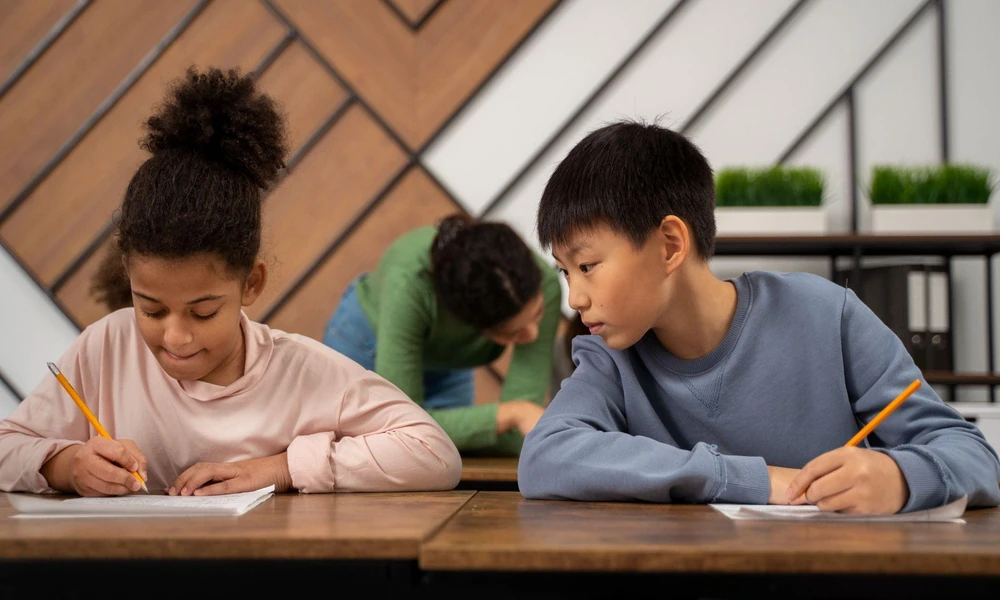

Children develop through more than academic lessons. Their school experience can also influence communication, creativity, confidence, social skills and independence. Parents exploring holistic education in Singapore may therefore want to consider how a school approaches the child’s wider development alongside academic learning.
1. Academic Learning
A broad educational approach should still provide a clear academic foundation. Parents can ask how the school teaches core subjects and monitors progress.
Look at the balance between structured instruction and opportunities for students to apply what they have learnt. Children need opportunities to develop literacy, numeracy and subject knowledge while also learning how to use those skills in practical situations.
When considering holistic education in Singapore, parents should identify how academic expectations fit with the school’s wider approach. A broader educational philosophy does not remove the need for clear learning goals.
2. Character and Social Development
Children develop social habits through everyday interactions. Parents can ask how schools encourage cooperation, respect, responsibility and communication.
Group activities can provide opportunities for pupils to listen to others, contribute ideas and work towards shared outcomes. Teachers may also use classroom routines to encourage students to take responsibility for tasks.
Ask how the school handles disagreements and supports positive relationships. These details can provide a clearer understanding of how character development appears in daily school life.
3. Creativity and Exploration
Creative activities can give children opportunities to experiment, express ideas and approach problems from different perspectives. Parents can ask how the school incorporates art, music, design, performance or project work.
Creativity does not need to be limited to specialist lessons. Teachers can also encourage students to explore different ways of solving problems or presenting their understanding.
For families exploring holistic education in Singapore, these opportunities may form an important part of the child’s overall learning experience.
4. Emotional and Personal Development
Children may encounter frustration, uncertainty and challenges as they learn. Parents can ask how the school supports students in developing self-awareness, resilience and appropriate ways of managing difficulties.
This does not mean expecting teachers to address every personal challenge. Instead, families can ask what pastoral structures, classroom practices or communication channels are available when a child needs additional support.
Parents should also consider how teachers encourage students to reflect on their learning and take responsibility for improvement.
5. Independence and Responsibility
Independence develops gradually. Schools can support it by giving children age-appropriate responsibilities and opportunities to make choices.
Parents can ask how students manage classroom tasks, organise materials, complete projects and contribute to school activities. These experiences can help children become more comfortable taking responsibility for their learning.
A school that supports independence may still provide clear structure. The balance between guidance and responsibility is worth discussing before enrolment.
6. Family and School Partnership
Parents remain an important part of a child’s development. Ask how the school communicates with families and how parents can stay informed about academic and personal progress.
Regular communication can help parents understand what their child is experiencing at school and identify areas where home and school routines can support one another.
What to Compare
| Area | Questions to consider |
| Academics | Are core learning goals clearly defined? |
| Character | How are cooperation and responsibility encouraged? |
| Creativity | How often do students explore creative activities? |
| Personal development | What support is available when students face challenges? |
| Independence | Are children given age-appropriate responsibilities? |
| Family partnership | How does the school communicate with parents? |
Holistic education in Singapore can take different forms, so parents should look at the actual practices behind a school’s educational philosophy. Consider academic expectations alongside social development, creativity, independence and communication.
A suitable environment should reflect the child’s age, learning preferences and developmental needs. Visiting the school and asking specific questions can help parents understand how its approach operates in everyday learning.
Contact TLS Academy to discuss its educational approach and how it can support your child’s wider learning and development.


The Basic Types of Communication Training for An Organization
